After pregnancy, a small ridge may appear along the abdomen when you sit up, cough, or lift your baby. This can happen with diastasis recti, a widening between the abdominal muscles. It is common, but each person’s symptoms and recovery differ. Some people notice little discomfort. Others feel weakness, pressure, or difficulty managing everyday movements. So, can hi emt machine help with postpartum diastasis recti? The honest answer depends on the device, the person, and the quality of the evidence.
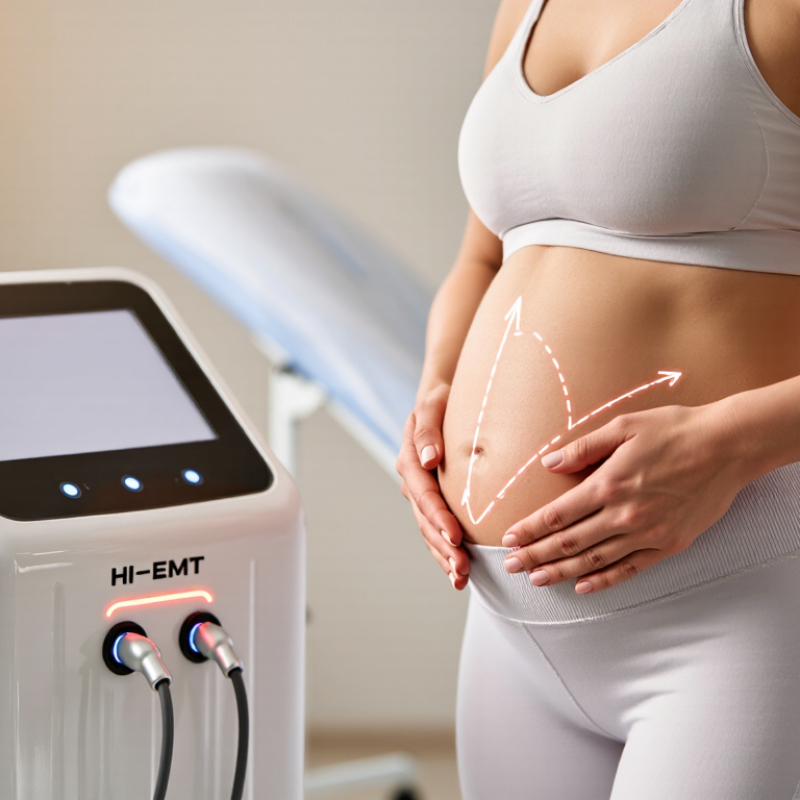
HI-EMT machines are marketed to trigger muscle contractions using electromagnetic energy. That may sound appealing when finding time for exercise feels difficult. But a contraction is not proof that the gap has closed or that the abdominal wall works better during daily activities. Evidence for these devices specifically after childbirth remains limited, and marketing claims can sound more certain than the research allows. That matters. A qualified healthcare professional, such as a pelvic health physiotherapist, can assess symptoms and guide a gradual return to suitable exercises. Seek advice before using a device, especially if you have pain, ongoing bleeding, a recent cesarean birth, or another medical concern. Recovery is not always neat or quick. Sometimes progress is simply lifting a stroller with less discomfort. This article looks at what EMS may—and may not—offer, what evidence can tell us, and which questions to ask before considering treatment.
Understanding Postpartum Diastasis Recti and Its Causes
Postpartum diastasis recti occurs when the abdominal muscles separate along the linea alba, a connective tissue strip at the midline. Pregnancy stretches this tissue as the uterus expands, especially during the third trimester. Hormonal changes may also reduce tissue firmness. The gap can appear around the navel, above it, or below it.
It is not simply a “weak stomach.” Repeated pressure from coughing, constipation, heavy lifting, or poor movement patterns may increase symptoms. Some people notice a ridge or doming when sitting up. Others feel lower-back discomfort, abdominal weakness, or poor trunk control. The picture is not always neat. A visible gap does not automatically show the condition’s severity.
Assessment by a qualified pelvic health physiotherapist or medical professional can examine tissue tension, breathing, posture, and functional strength. An EMS machine may create muscle contractions, but it does not repair stretched connective tissue by itself. Research and clinical practice generally place breathing work, gentle deep-core training, and progressive rehabilitation at the center of care. Exercises should match healing status, delivery history, pain, and pelvic-floor symptoms. I once assumed harder abdominal work meant faster recovery; postpartum bodies often prove that assumption wrong. Persistent pain, bulging, or pressure deserves professional review.
How EMS Muscle Stimulation Works
How EMS Muscle Stimulation Works
Electrical muscle stimulation (EMS) sends low-level pulses through skin electrodes. These pulses activate motor nerves, causing nearby muscles to contract. You may feel a rhythmic tightening beneath the pads, even while sitting still. The contraction is real, but it is not the same as coordinating your deep abdominal muscles during lifting, coughing, or getting out of bed. That distinction matters. EMS may support muscle activation; it does not directly stitch separated connective tissue back together.
For postpartum diastasis recti, evidence specific to EMS remains limited. A 2016 study in the British Journal of Sports Medicine followed 300 first-time mothers and found diastasis in 60% at six weeks, 45.4% at six months, and 32.6% at twelve months after birth. Those figures show that recovery can continue over time, but they do not prove EMS causes improvement. The U.S. Food and Drug Administration describes EMS devices as producing muscle contractions, while cautioning that stimulation alone should not be expected to create major body changes. A pelvic health physiotherapist can assess abdominal function and guide suitable exercises; ask before using EMS, especially if you have pain, pelvic symptoms, or a C-section incision that is still healing. It is easy to mistake a strong contraction for better everyday control. That deserves a closer look.
Can EMS Machine Help With Postpartum Diastasis Recti? – How EMS Muscle Stimulation Works
| Topic |
What is known |
Practical takeaway |
| What diastasis recti is |
A widening and thinning of the linea alba between the two rectus abdominis muscles. It is common during and after pregnancy. |
It is not the same as an abdominal hernia. A clinician can assess symptoms, abdominal function, and whether a hernia may also be present. |
| How it is measured |
The inter-recti distance may be assessed by palpation or imaging, such as ultrasound. Measurement results can vary with the location and method used. |
A single gap measurement does not fully describe strength, symptoms, or everyday function. |
| How EMS works |
Electrical muscle stimulation sends electrical impulses through surface electrodes to produce muscle contractions. The response depends on the device, electrode placement, settings, and individual factors. |
EMS can create a contraction, but this alone does not show that the abdominal gap has closed or that core function has improved. |
| Evidence for postpartum diastasis |
Research on EMS specifically for postpartum diastasis recti is limited. Evidence does not establish EMS as a stand-alone treatment that reliably closes the gap. |
Treat EMS as a possible adjunct—not a proven replacement for individualized assessment and rehabilitation. |
| Rehabilitation approach |
Postpartum rehabilitation commonly focuses on gradual return to activity, breathing and pressure management, and coordinated abdominal and pelvic-floor function. Exercise should be adapted to symptoms and recovery. |
A pelvic-health physical therapist or other qualified clinician can help select and progress exercises safely. |
| When to seek assessment |
Consider professional advice for persistent pain, a pronounced bulge, difficulty with daily activities, worsening symptoms, or concern about a hernia. Seek urgent care for severe or sudden symptoms. |
Get individualized guidance before starting abdominal stimulation or a new exercise program, particularly during early postpartum recovery. |
| Safety considerations |
Electrical stimulation may be unsuitable in some situations, including certain implanted electronic devices or areas with impaired sensation. Restrictions vary by device and medical circumstances. |
Follow the device instructions and ask a healthcare professional about personal contraindications. Do not place electrodes over the uterus during pregnancy. |
| Bottom line |
EMS can stimulate abdominal muscle contractions, but its specific benefit for postpartum diastasis recti remains uncertain. |
If used, it is best considered alongside—not instead of—appropriate clinical assessment and a progressive rehabilitation plan. |
General educational information only; it is not a diagnosis or a substitute for personalized medical advice. Reference context: European Hernia Society guidelines on rectus diastasis and postpartum physical-activity guidance from the American College of Obstetricians and Gynecologists.
Potential Benefits and Limits of EMS for Abdominal Separation
Can EMS Machine Help With Postpartum Diastasis Recti?
Postpartum abdominal separation is common, but measurement methods differ. Sperstad et al. reported diastasis in about 60% of women six weeks after birth. The rate fell to roughly 32.6% after 12 months. These figures come from a British Journal of Sports Medicine study published in 2016. They show recovery can continue naturally, although symptoms may remain.
EMS may create visible abdominal contractions through controlled electrical impulses. It could support muscle awareness when normal activation feels difficult. However, evidence for EMS specifically treating postpartum diastasis recti remains limited. Small studies often use different devices, settings, and exercise programs. That makes direct comparisons unreliable. A stronger contraction is not automatically better healing. This distinction matters.
The American College of Obstetricians and Gynecologists recommends gradual postpartum activity, including 150 minutes of moderate exercise weekly when medically appropriate. EMS should complement breathing practice, pelvic-floor coordination, and progressive core exercises. It should not replace them. A qualified physiotherapist can assess abdominal tension, doming, pain, and functional control. Avoid treatment over numb skin, open wounds, or without medical clearance after complications. The honest gap remains: EMS sounds promising, but robust postpartum trials are still needed.
How EMS May Fit Into Postpartum Diastasis Recti Care
Electrical muscle stimulation (EMS) can produce abdominal muscle contractions and may support muscle activation when used as an adjunct to rehabilitation. However, direct evidence that EMS alone reduces inter-recti distance or repairs abdominal separation remains limited. Assessment by a qualified healthcare professional and progressive exercise remain important.
Safety Considerations and When to Begin Treatment
An EMS machine may support gentle abdominal muscle activation after childbirth, but it cannot “close” diastasis recti by itself. The research remains limited, and results vary between individuals. A qualified physiotherapist or obstetric clinician should assess your abdominal wall, breathing pattern, pelvic floor, and scar tissue first. A visible gap is only one part of the assessment.
Timing matters. Do not begin EMS during heavy bleeding, fever, infection, open wounds, or severe pain. Wait for medical clearance after delivery, especially following a cesarean birth. The usual postpartum check is only a guide, not a universal starting date. Healing can take longer when the scar feels numb, tight, or tender. Too soon can backfire.
Electrodes should never cover broken skin, irritated tissue, or a healing incision. Extra caution is needed with reduced sensation, pelvic pain, urinary leakage, or a suspected hernia. People with implanted electronic devices should seek specialist advice before using electrical stimulation. Begin with low intensity and short sessions under professional supervision. Stop if you notice sharp pain, dizziness, increased bulging, bleeding, or unusual pressure. A common assumption is that stronger stimulation means faster recovery. That assumption needs revision. Comfortable breathing, controlled movement, and gradual core exercises may be more important than intensity.
How EMS Fits Into Postpartum Rehabilitation
Can EMS Machine Help With Postpartum Diastasis Recti?
How EMS Fits Into Postpartum Rehabilitation
Postpartum diastasis recti is a change in the connective tissue between the abdominal muscles. Recovery varies, and a visible gap alone does not show how well the core functions. Electrical muscle stimulation (EMS) may prompt abdominal muscles to contract, but it cannot repair tissue or replace guided exercise. Evidence for EMS specifically after childbirth remains limited. Think of it as a possible support, not a shortcut. Rehabilitation often focuses on breathing, gradual core loading, and everyday tasks, such as lifting a baby without holding your breath. Small steps matter.
Tips: Ask a pelvic health physiotherapist or clinician whether EMS suits your recovery. Get clearance before placing electrodes on your abdomen, especially after a cesarean birth or if you have pain, unusual bleeding, or other concerns. Use only settings and placement recommended by a qualified professional. Stop if stimulation causes pain or feels wrong.
EMS may be considered alongside a personalized program when a clinician finds it appropriate. It does not work equally for everyone, and stronger contractions are not automatically better. Some days, progress feels obvious; other days, it does not. That can be frustrating. Track comfort and function, not just the gap’s width, and revisit the plan if symptoms persist or worsen.
Conclusion
Postpartum diastasis recti occurs when the abdominal muscles and connective tissue remain stretched or weakened after pregnancy, often causing a visible gap, core instability, or lower-back discomfort. EMS, or electrical muscle stimulation, uses gentle electrical impulses to encourage abdominal muscle contractions. This may help improve muscle awareness, support gradual strengthening, and complement a structured postpartum exercise program. However, can hi emt machine help with postpartum diastasis recti is not a question with a universal yes-or-no answer: EMS cannot physically close the separation on its own and should not replace breathing work, pelvic-floor training, posture correction, or professionally guided core exercises.
Treatment should begin only after appropriate postpartum recovery and medical clearance, especially following delivery complications or surgery. The intensity and placement of stimulation should be adjusted carefully, and use should stop if it causes pain, unusual discomfort, or increased abdominal pressure. A qualified healthcare professional can assess the severity of the separation and determine whether EMS is suitable as part of a safe, gradual rehabilitation plan.

 Yiki Beauty